
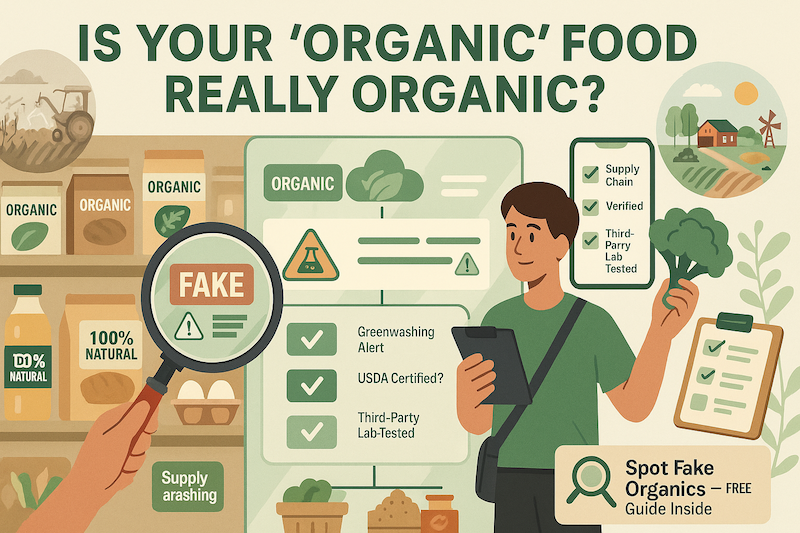
Is Your ‘Organic’ Food Really Organic? The Misleading Truth Exposed
You carefully read the label, see that green “USDA Organic” seal, and feel good about spending 40% more for what you believe is cleaner, safer food. But what if that premium-priced organic produce sitting in your cart isn’t actually organic at all?
The uncomfortable truth is that organic food fraud is a massive, billion-dollar problem that’s growing every year. From fake certificates to mislabeled imports, millions of consumers are unknowingly purchasing conventional food at organic prices. Even more concerning, the labeling system itself contains loopholes that allow products to be called “organic” while containing non-organic ingredients.
The Massive Loopholes in “Organic” Labeling
Before diving into outright fraud, let’s examine the legal ways your “organic” food might not be as organic as you think.
The “Made with Organic” Deception
Walk down any grocery aisle and you’ll see products prominently displaying “organic” on their packaging. However, there are actually three different levels of organic certification that most consumers don’t understand:
- “100% Organic”: Contains only organic ingredients
- “Organic”: Contains at least 95% organic ingredients
- “Made with Organic Ingredients”: Contains only 70% organic ingredients
That “Made with Organic” label means 30% of your expensive “organic” product can be completely conventional, including GMO ingredients, synthetic preservatives, and conventional produce treated with prohibited pesticides.
The Pesticide Myth
One of the biggest misconceptions about organic food is that it’s pesticide-free. This simply isn’t true. Organic farming uses pesticides – they just have to be on the USDA’s approved list of “natural” pesticides.
A 2021 study published in Food Chemistry found that 21% of certified organic produce samples contained pesticide residues. In some cases, these “natural” organic pesticides are actually more toxic than their synthetic counterparts. Copper sulfate, for example, is permitted in organic farming but can leave dangerous residues and pollute waterways.
Import Loopholes
Here’s where things get really problematic. The U.S. imports massive quantities of organic grains and produce from countries with questionable oversight. According to industry data:
- 26% of organic corn used in the U.S. comes from abroad
- 76% of organic soybeans are imported, primarily from regions known for fraudulent shipments
Many of these imports come from the Black Sea region, Turkey, India, and China – areas where organic oversight is minimal and fraud is common.
Common Misleading Practices by Brands
Beyond legal loopholes, the organic industry is plagued by deceptive marketing practices that trick consumers into paying premium prices.
Greenwashing Through Packaging
Food companies spend billions on packaging designed to suggest organic, natural, and healthy properties. Research shows that 60-90% of consumer purchasing decisions are based on color alone. Companies exploit this by using:
- Green packaging and plant imagery
- Words like “natural,” “pure,” and “clean” (which have no legal meaning)
- Images of farms and fresh produce
- Earth-tone color schemes
The “Natural” Scam
Unlike “organic,” the term “natural” has no FDA definition or oversight. A product loaded with high fructose corn syrup, artificial flavors, and preservatives can legally be labeled “all-natural” because these ingredients technically come from natural sources.
Certificate Shopping
With over 80 different certifying agencies operating in the U.S., some companies “shop around” for the most lenient certifiers. Each agency is responsible for monitoring roughly 583 facilities but only required to test 5% annually. This means 95% of organic operations could go untested for years.
The Fraud Epidemic: Real Cases That Should Shock You
Organic food fraud isn’t just about misleading labels – it’s about criminals deliberately passing off conventional food as organic to capture premium prices.
The $12 Million Raspberry Heist
In 2019, a $12 million shipment of supposedly organic raspberries was intercepted at the Chilean border. The berries were actually grown conventionally in China, shipped to Chile, and given fake organic certificates claiming they were locally grown Chilean organic produce.
The Black Sea Grain Scandal
Washington Post investigations revealed massive fraud in organic grain imports from Turkey and Ukraine. Millions of pounds of conventional corn and soybeans were being imported with fake organic certificates. One organic farmer tracked 13 suspect ships carrying fraudulent organic grains over several years.
The $70 Million Midwest Scam
In 2021, Minnesota farmer James Wolf was sentenced to federal prison for running a $70 million organic fraud operation. For seven years, he sold conventional soybeans, corn, and wheat as certified organic to farmers across the Midwest.
The Scale of the Problem
According to the Organic Farmers Association, fraud is “unquestionably the biggest threat to organic.” The scale includes:
- Hundreds of truckloads of fraudulent products
- Numerous large ocean-going vessels carrying fake organic goods
- Hundreds of millions of dollars in fraudulent sales annually
The USDA’s own 2017 audit found the agency “unable to provide reasonable assurance” that required organic documents were being properly reviewed at U.S. ports of entry.
How to Verify What’s Really Organic
Don’t lose hope – there are ways to protect yourself and find genuinely organic products. Here’s your step-by-step verification system:
Step 1: Master Label Reading
Look for these specific certifications:
- USDA Organic seal: The gold standard, but verify it’s the real seal
- Demeter Biodynamic: Even stricter than USDA Organic
- Real Organic Project: Addresses many USDA loopholes
Avoid these misleading terms:
- “Natural” or “All-Natural”
- “Made with Organic” (unless you’re okay with 30% non-organic)
- “Eco-friendly” or “Earth-friendly”
- “Pure” or “Clean”
Step 2: Research the Source
Use the USDA Organic Integrity Database: This searchable database lets you verify any organic operation’s certification status. Simply enter the farm or facility name to confirm their certification is current and legitimate.
Check the certifying agency: Look for the certifier’s name on the package (it’s required by law). Research whether that agency has a good reputation for strict oversight.
Step 3: Know Your Risk Zones
Higher fraud risk products:
- Imported grains (especially from Turkey, Ukraine, India)
- Processed foods with long ingredient lists
- Products significantly cheaper than other organic alternatives
- Items from unfamiliar brands without established reputations
Lower fraud risk products:
- Locally grown produce from farmers you can visit
- Products from established organic brands with strong reputations
- Items with multiple certifications (USDA Organic + another standard)
Step 4: Support Direct Relationships
The most reliable organic food comes from sources you can verify personally:
- Farmers markets: Talk directly to growers about their practices
- CSA boxes: Community Supported Agriculture from local farms
- Farm visits: See the operation firsthand
- Co-ops: Often have stricter vetting than chain stores
Your Smart Organic Shopping Checklist
Print this checklist and keep it in your wallet for every shopping trip:
Before You Buy:
□ Check the exact wording: Is it “100% Organic,” “Organic,” or just “Made with Organic”?
□ Verify the USDA seal: Is it the official green and white circular seal?
□ Find the certifying agency: Is it listed on the package?
□ Check country of origin: Be extra cautious with imports from high-risk regions
□ Compare prices: If it’s suspiciously cheap for organic, investigate further
□ Read ALL ingredients: Even in “organic” products, some ingredients may be conventional
Red Flags to Avoid:
⚠️ Missing USDA seal but claims to be organic
⚠️ Vague terms like “natural” or “eco-friendly” instead of “organic”
⚠️ No certifying agency listed anywhere on the package
⚠️ Prices too good to be true compared to other organic options
⚠️ Suspicious origin stories or unclear supply chain information
Advanced Verification Steps:
- Use smartphone apps: HarvestMark and similar apps can trace some products back to their source
- Contact the manufacturer: Ask specific questions about their organic certification and supply chain
- Check online reviews: Other consumers often expose fraudulent products
- Join consumer groups: Organizations like Consumer Reports regularly test and expose mislabeled products
The Bottom Line: Protecting Your Family and Wallet
The organic food industry is worth over $180 billion annually, and where there’s money, there’s fraud. While the majority of organic farmers are honest and following the rules, the system has enough loopholes and weak enforcement to allow widespread deception.
The key is becoming a smart, informed consumer. You don’t have to stop buying organic – you just need to buy smarter. Focus on:
- Genuine “100% Organic” or “Organic” (95%+) products with proper certification
- Local sources you can verify
- Established brands with strong reputations
- Products with multiple certifications
Remember: paying extra for organic only makes sense if you’re actually getting organic. Use this guide to ensure your premium prices are going toward genuinely better food, not just better marketing.
Take Action: Get Our Free “Spot Fake Organics” Guide
Don’t let fraudulent organic food companies take advantage of your family’s health concerns and environmental values. Our comprehensive “Spot Fake Organics” guide includes:
- Wallet-sized checklist for shopping trips
- List of most trusted certifying agencies
- Red flag indicators for each major food category
- Links to verification databases
- Money-saving tips for finding genuine organic foods
Download your free guide today and join thousands of smart shoppers who refuse to be tricked by misleading organic labels. Your family’s health – and your wallet – will thank you.
🌱 Get Your Free “Spot Fake Organics” Guide
Stop overpaying for fake organic food!
Join 50,000+ smart shoppers who use our proven system to identify genuine organic products and avoid costly frauds.
No spam. Unsubscribe anytime. Your email is safe with us.

Vipin Sawhney is a Tech Strategist and Marathoner exploring the “ROI of Wellness.” Read full story →




One Comment